Showing posts with label Interview. Show all posts

Wednesday, January 9, 2013

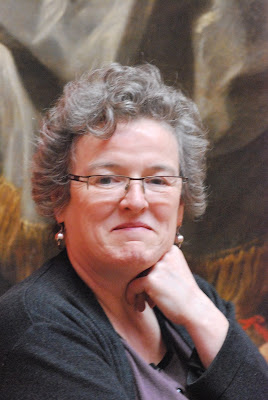
CONTRIBUTOR SPOTLIGHT: MARY MORRISSY


Mary Morrissy is the author of two novels, Mother of Pearl and The Pretender, and a collection of short stories, A Lazy Eye. Mother of Pearl was shortlisted for the Whitbread (now Costa) Award; The Pretender was nominated for the Dublin IMPAC Award. She was a recipient of a prestigious Lannan Foundation Award and her short fiction has won the Hennessy Award and been anthologized widely in the UK and Ireland. Her next novel, The Rising of Bella Casey, is forthcoming in 2013.
Morrissy’s lyrical and compelling story “Miss Ireland” appears in our upcoming double issue with a special focus on Ireland. We asked her to share some thoughts on the story with TCR readers.

What was the impetus for “Miss Ireland”? Tell us a little about how you came to write it.
“Miss Ireland” had its genesis in a story from my childhood that my mother used to refer to in hushed tones. A young mother had gassed herself and her two young children in a house on our street—this was before I was born so I never knew any of the details. But it stayed with me, mainly because as a teenager I was convinced that nothing ever happened in neighbourhoods like ours—suburban, respectable; this incident, mystifying and shocking, was in direct opposition to my lofty, adolescent view that I was surrounded by placid, self-satisfied dullness in a place where nothing happened. 

“Miss Ireland” begins dramatically: “The maid stuck her head in the gas oven one Sunday afternoon in the Devoy house, 27 Vandeleur Drive, but not before she had fed and changed the baby—Fergal, it was—and put him down for his nap.” Conflict increases all the more when, in the same paragraph, the mother of the household reacts with “selfish relief.” Family dynamic creates much of the tension in “Miss Ireland,” before and after the suicide. How did family roles and plot structure evolve in revision?
My original idea was to write the story from the point of view of the maid, then Irene appeared and took over, I’m afraid. It seemed more interesting to view Quinny through her eyes because Irene can’t recognise what’s in front of her. In many ways, that is Quinny’s tragedy—that she finds herself in a world that won’t or can’t empathise with her situation and that world is the family. Although the story is set in and plays out within the family, I’m hoping it has wider resonances. One of the debates that has exercised public interest in Ireland is how much ordinary people knew about the maltreatment and abuse of children in state and church care during this period. The answer, I think, is that they knew and they didn’t know—much like Irene, who instinctively senses Quinny’s plight, but consciously hasn’t a clue.
   
How would you consider the story to reflect or comment upon your experience of Ireland?
The story is set in the Sixties in Ireland, in 1965 to be precise. (The 50th anniversary of the 1916 Easter Rising is mentioned as “upcoming.”)  In nuance, it reflects the period of my childhood. The very fact that there are still maids in evidence speaks of a time that seems pre-historic, even to me. The Sixties came late to Ireland, so my memory of the decade was one of traditional, conservative values. What drives Irene, the mother in the story, is a sense of respectability and constraint. At that time there were very well-defined roles imposed on women and men and the influence of the Catholic Church was paramount. A sub-theme in the story is an exploration of national and female identity—Irene has represented Ireland in a beauty contest, but Quinny represents an altogether different version of the female, Irish experience of the time.

Where do you go for writing inspiration in general?
For novels, I can never predict where the idea will come from. My novels have been historical but only because the stories that have really fired me happen to be from the past. I can’t really say why a baby kidnap in Dublin of the 1950s (my first novel, Mother of Pearl) or the story of Anna Anderson, the woman who spent her whole life insisting she was the Russian Grand Duchess Anastasia (The Pretender, my second novel), captured my imagination. What unites them is that they feature real people and inhabit a territory somewhere between fiction and biography.
My most recent novel, The Rising of Bella Casey, is the story of a 19th century schoolteacher whose life is turned to ruin by a secret sexual obsession. It’s based on the life of the sister of Irish playwright Sean O’Casey, whose writing about her is woven into the narrative. The trajectory of Bella’s story is heartbreaking, a riches-to-rags narrative, and once it took hold it just would not let go.
My short fiction is usually more personal and generally contemporary—the smallest trigger can set an idea whirring, sometimes an image, something someone says, chance encounters, memories.

What are you working on now? What can readers look forward to?
“Miss Ireland” is part of a linked cycle of stories that I’m close to finishing. After that, I have two novels in line waiting to be written. My novel The Rising of Bella Casey is due to be published in 2013.
    
Subscribe now for $16 to read “Miss Ireland” and many other Irish pieces in our Irish double issue! Your subscription will also include a spring issue featuring the winners of our Lamar York Prizes for Fiction and Nonfiction.

Wednesday, January 25, 2012

I Don't Know What to Think About What People Will Think: An Interview with Blake Butler


I wanted to interview Blake Butler for a number of reasons, but in part due to his novel, There Is No Year, released last year from Harper Perennial. He has also written a novel-in-stories, Scorch Atlas (Featherproof Books, 2009), and a novella, Ever (Calamari Press, 2008). He published the chapbook Pretend I Am There But Very Little with Publishing Genius in 2008. His stories, reviews, creative nonfiction, and lists have appeared in many magazines, including Black Warrior Review, Post Road, The Believer, and Copper Nickel. He is the editor and co-founder of HTMLGiant, “The Internet Literature Magazine Blog of the Future.” He runs the reading series Solar Anus in Atlanta, where he lives. I’ve known Blake since 2007, after we’d recognized each other’s work in literary magazines and saw from our respective bios that we both lived in Atlanta. Blake remains not only a good friend, but one of the most dedicated, thoughtful, interesting, and discussion-provoking practitioners of discourse in the English language that I know. To read more from Blake, or to purchase his books, see his blog: www.gillesdeleuzecommittedsuicideandsowilldrphil.com


Jamie Iredell: You've “come up,” as they might say, relatively quickly on the “literary scene.” A couple of years ago you were publishing in obscure literary journals, writing your blog, and publishing your own magazine. Then you started publishing in some “higher profile” magazines; published your first book, the novella, Ever; and started HTMLGiant (with Gene Morgan). Your second book, Scorch Atlas, came quickly thereafter, from the design-savvy small press, Featherproof Books. Finally, you landed a two-book deal with a major New York publisher, and last spring saw the first release as a result, the novel, There Is No Year. You've accomplished much in a short period of time. What would you say you're most proud of, and to what would you attribute your rapid “rise”?

Blake Butler: I'm happy with how things have happened. I honestly try not to dote too long on anything in particular I've done, beyond the moment of it being taken out of my hands. I like to obsess about the thing for years while I can change itthough that obsession never seems to stopso the less I think about where I've been the closer I feel to being able to move forward. I like to look at my books when I'm on the toilet, really. That's the time I give myself to think about me. I do cherish my daily routine, the coming to the desk, the being at the desk, the circling of created space, though at this point I can't tell if that's something to be proud of or something to hide like murder. I sometimes wonder what the effect this daily sinking into total fabrication is going to end up doing to me ten years down the line.  Or twenty. Or two. I don't know. But the pattern and the tunnel of it is the thing itself, and it might also be the thing I should attribute to why I've gotten anywhere at all in what you call a “rise”: the only way I've been able to find myself making something I would ever show anyone else is by beating my head against it until I can no longer recognize it as mine.

JI: Of your three books, each seems to focus (maybe obsess is the better word?) on a few particulars. All of them are concerned with families and familial relationships. Ever and There Is No Year both take place mostly inside a home, and that home becomes a character itself, shifting and changing, full of strange phenomena. To a lesser extent Scorch Atlas also focuses on architectural events, but that book is filled with apocalyptic weather. In Scorch Atlas it feels like the external environments of each story become active players. These elements are mutable it seems, from one perspective at least, so that the humans must react to them. It feels like Naturalism in some ways, like Stephen Crane's "The Open Boat." Why does your fiction tend to move in this direction? Do you see these elements as characters no different than the unnamed humans who occupy your fiction?

BB: I think instead of seeing the inert as characters, more often I don't see characters at all. The construct of a “character” to me is automatically damning because it kind of sets up this framework for the creation that insists it is a stage set, or that there is something like the creator lurking behind it, which I don't like. Your term “active players” here is closer to what I might think of things as, though really I try not to think about the elements as objects or as personas, but as extensions of a kind of light or air around the body of what the book is.

JI: You have a nonfiction book released last year from Harper Perennial, titled Nothing: A Portrait of Insomia. Tell me about that book. How was the experience of shifting from fiction to nonfiction? Did you do a lot of research for the book? How did you like that? Would you say that this book will be informative, educational, academic?

BB: I had a lot of fun playing with Nothing. It began with the idea of writing a full-length piece of nonfiction based on my experience with sleep trouble and the consciousness of that, and kind of wormed into a hybrid of a lot of different forms, historical, scientific, fantastical, remembered, dream-life, fantasy, hypnotic research, close reading, etc. I ended up writing about 150,000 words for the first draft, which then I cut down to nearly half, so it's a pretty condensed object, and I think it takes on a lot of different approaches and invokes a different kind of air than I'd expected or than I've experienced before. I did do a lot of research, and I had fun using outside sources for once both as a fuel and as jumping-off points. There's a lot of information and metanarrative pulled out of both how sleep and sleeplessness works and its effects both on me as an individual, and kind of the whole scope of existing as human while the onslaught of want for our attention and entertainment continues to gather up in this weird ball of air that seems to be continually rising over everything. I really had a blast melding all these things together and playing with them and bending things for pleasure, in a different way than fiction allows. It definitely expanded my idea of how to write, and my proclivities. I don't know what to think about what people will think of it, but that's maybe the best brain space there is.


Jamie Iredell is the author of two books: The Book of Freaks (Future Tense Books, 2011), and Prose. Poems. A Novel. (Orange Alert Press, 2009).