
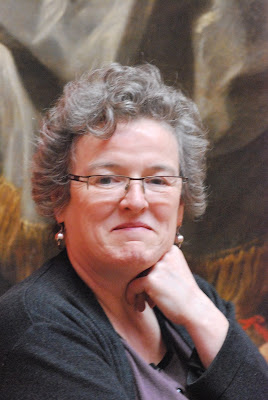
Mary Morrissy is the author of two novels, Mother of Pearl and The Pretender, and a collection of short stories, A Lazy Eye. Mother of Pearl was shortlisted for the Whitbread (now Costa) Award; The Pretender was nominated for the Dublin IMPAC Award. She was a recipient of a prestigious Lannan Foundation Award and her short fiction has won the Hennessy Award and been anthologized widely in the UK and Ireland. Her next novel, The Rising of Bella Casey, is forthcoming in 2013.
Morrissy’s lyrical and compelling story “Miss Ireland” appears in our upcoming double issue with a special focus on Ireland. We asked her to share some thoughts on the story with TCR readers.
What was the impetus for “Miss Ireland”? Tell us a little about how you came to write it.
“Miss Ireland” had its genesis in a story from my childhood that my mother used to refer to in hushed tones. A young mother had gassed herself and her two young children in a house on our street—this was before I was born so I never knew any of the details. But it stayed with me, mainly because as a teenager I was convinced that nothing ever happened in neighbourhoods like ours—suburban, respectable; this incident, mystifying and shocking, was in direct opposition to my lofty, adolescent view that I was surrounded by placid, self-satisfied dullness in a place where nothing happened.
“Miss Ireland” begins dramatically: “The maid stuck her head in the gas oven one Sunday afternoon in the Devoy house, 27 Vandeleur Drive, but not before she had fed and changed the baby—Fergal, it was—and put him down for his nap.” Conflict increases all the more when, in the same paragraph, the mother of the household reacts with “selfish relief.” Family dynamic creates much of the tension in “Miss Ireland,” before and after the suicide. How did family roles and plot structure evolve in revision?
My original idea was to write the story from the point of view of the maid, then Irene appeared and took over, I’m afraid. It seemed more interesting to view Quinny through her eyes because Irene can’t recognise what’s in front of her. In many ways, that is Quinny’s tragedy—that she finds herself in a world that won’t or can’t empathise with her situation and that world is the family. Although the story is set in and plays out within the family, I’m hoping it has wider resonances. One of the debates that has exercised public interest in Ireland is how much ordinary people knew about the maltreatment and abuse of children in state and church care during this period. The answer, I think, is that they knew and they didn’t know—much like Irene, who instinctively senses Quinny’s plight, but consciously hasn’t a clue.
How would you consider the story to reflect or comment upon your experience of Ireland?
The story is set in the Sixties in Ireland, in 1965 to be precise. (The 50th anniversary of the 1916 Easter Rising is mentioned as “upcoming.”) In nuance, it reflects the period of my childhood. The very fact that there are still maids in evidence speaks of a time that seems pre-historic, even to me. The Sixties came late to Ireland, so my memory of the decade was one of traditional, conservative values. What drives Irene, the mother in the story, is a sense of respectability and constraint. At that time there were very well-defined roles imposed on women and men and the influence of the Catholic Church was paramount. A sub-theme in the story is an exploration of national and female identity—Irene has represented Ireland in a beauty contest, but Quinny represents an altogether different version of the female, Irish experience of the time.
Where do you go for writing inspiration in general?
For novels, I can never predict where the idea will come from. My novels have been historical but only because the stories that have really fired me happen to be from the past. I can’t really say why a baby kidnap in Dublin of the 1950s (my first novel, Mother of Pearl) or the story of Anna Anderson, the woman who spent her whole life insisting she was the Russian Grand Duchess Anastasia (The Pretender, my second novel), captured my imagination. What unites them is that they feature real people and inhabit a territory somewhere between fiction and biography.
My most recent novel, The Rising of Bella Casey, is the story of a 19th century schoolteacher whose life is turned to ruin by a secret sexual obsession. It’s based on the life of the sister of Irish playwright Sean O’Casey, whose writing about her is woven into the narrative. The trajectory of Bella’s story is heartbreaking, a riches-to-rags narrative, and once it took hold it just would not let go.
My short fiction is usually more personal and generally contemporary—the smallest trigger can set an idea whirring, sometimes an image, something someone says, chance encounters, memories.
What are you working on now? What can readers look forward to?
“Miss Ireland” is part of a linked cycle of stories that I’m close to finishing. After that, I have two novels in line waiting to be written. My novel The Rising of Bella Casey is due to be published in 2013.
Subscribe now for $16 to read “Miss Ireland” and many other Irish pieces in our Irish double issue! Your subscription will also include a spring issue featuring the winners of our Lamar York Prizes for Fiction and Nonfiction.

