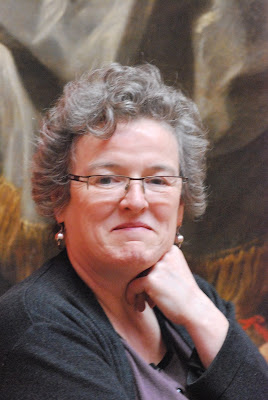
Amina Gautier is the winner of the Flannery O’Connor Award for Short Fiction for her short story collection At-Risk. More than seventy-five of her stories have been published, appearing in Best African American Fiction, The Chattahoochee Review, Glimmer Train, Iowa Review, Kenyon Review, North American Review, and Southern Review, among other places. Her stories have won the Crazyhorse Fiction Prize, the Danahy Prize, the Jack Dyer Prize, the Schlafly Microfiction Award, and the William Richey Award as well as scholarships and fellowships from the American Antiquarian Society, Breadloaf Writer’s Conference, Sewanee Writer’s Conference, and Ucross Foundation and artist grants from the Illinois Arts Council and the Pennsylvania Council on the Arts.
Gautier’s fully-imagined and poetic story “Bodega” appears in our upcoming Spring issue as the inaugural Winner of the Lamar York Prize for Fiction. We asked her to share some thoughts on the story with TCR readers.
What was the inspiration for “Bodega”? Tell us about how you came to write it.
Although I have lived in a number of towns and cities, I am a native New Yorker and being a New Yorker is something one is born into, something one can never stop being no matter where one moves and takes up residence, something one can never "pick up" if one has moved to New York from some other place. When you are a native New Yorker, you are a child of bodegas, neighborhood stores. Depending on the section of New York that informs your background, these bodegas are sometimes the only places in your neighborhood for grocery shopping. Oftentimes a neighborhood may have only one supermarket—a C-Town, Key Food, Pathmark or Associated for the entire community. For some folks, that supermarket might only be two blocks away; for others, it might be twenty. The bodega suffices as a convenient place to obtain groceries, certainly, but also as a reminder of one's own marginalization, a sign post that reminds one of the social and economic disparities in one's community that have made the bodega both necessary and profitable in the first place. The bodegas are permanent neighborhood fixtures. As a child, you pass these bodegas and drop in every day on the way to school and—later—on the way to catch public transportation. You gain a familiarity with those proprietors that you never seek with the cashiers in your local supermarket. The owners are people you come to know. Their faces are ones you come to recognize and know well during the long years of childhood.
Protagonist Nelida is an unlikely business woman, unlikely surrogate mother, unlikely migrant. Is she representative in a way that’s important to your vision as a writer?
Nelida is an important character for me as a writer because she embodies "between-ness." In this particular instance, she is representative of cultural, political, social, physical, and linguistic between-ness, but the various forms "between-ness" can take is something I have always explored and continue to explore in my fiction and my many short stories.
The story follows Nelida through a routine hour, the hour before she opens her family’s bodega, “the quietest hour of the day.” As a writer clearly interested in characterization, interiority in particular, and sentence-level beauty, how much attention do you give to pacing? Were you thinking of immediacy when you chose to have Nelida search for a letter from her son? How important is urgency, in your opinion, to a general literary audience?
I am always aware of pacing and I manipulate grammar, punctuation and stylistic conventions (synecdoche, metonymy, repetition, sibilance, etc.) in order to control the pacing of a story at the level of the sentence. However, I think there is an important distinction to be made between "urgency" and "quickness." As a writer, I am always interested and invested in "urgency," that pressing importance that guides one sentence into the next and goads a character from a state of inactiveness into one of activeness, but I sense that much of the general reading audience is more invested in quickness. When I hear books praised for the speed with which they were written, or the speed with which they can be read, I am completely puzzled as to why speed has become the criterion by which we express our preferences. I associate speed of writing with sloppiness of thought and craft. I certainly associate reading a book quickly with not reading or understanding it thoroughly. If you read so quickly that you never put the book down and are done with it two-to-three hours later, have you actually taken the time to understand it, to savor its language, craft and structure? Will you remember any poignant or resonant lines a week/month/year later from a book consumed so quickly? You’ve gulped down a meal. Sure, you ate it quickly and moved on to the next thing on your agenda, but did you really taste it? The books I enjoy most are the ones which compel me to put them down every so often because I have read something in them that I must ponder, just as the meals I enjoy most are the ones that compel me to put the fork down every so often because I have tasted something that I must savor.
When did you have a sense of how “Bodega” would end? What advice would you have for writers in general about a story’s trajectory, and where it ends up?
I envisioned the ending somewhere between the third and fifth draft, so, somewhere in the first month of working on the story. Although I worked on the story for another six months and played with the ending several times during several more drafts, the essentials of the ending were conceived early on. My advice would be: Don't force the writing. Follow the ending you believe you wish to pursue, while leaving yourself open to consider other endings that will suggest themselves as possibilities through the process of revision. Sometimes the ending is written first, sometimes it is written last. Sometimes the ending becomes the story's middle; the writer gets to what he or she thought was the end and realizes the story must go further. Sometimes the original ending turns out to ultimately be clunky, superficial, cliché, trite, too neat—such endings must be abandoned without remorse. Sometimes the original ending a writer conceived is not the appropriate ending for that story; sometimes it is meant to be the ending of some other story the writer has yet to write.
Where do you go for writing inspiration in general?
I go "outside" and "inside," which is to say that I go "outside" in the literal sense, i.e., I leave my home and engage with whatever landscape I happen to be part of at that time. It means I take trolleys and trains and walk around and look at various businesses, buildings and structures. It means I walk around and along lakes, ponds, rivers, beaches and paths and look at houses, hills, skies and cliffs. While "outside," I observe the world around me and look for things I wouldn't normally notice when I am rushing; I look for things I can only see when I am taking my time. Then I go "inside" which is to say I retreat inside my head to think over that which I have seen and interpret what it all means.
What are you working on now? What can readers look forward to?
Readers can look forward to more stories about Nelida and her family and about the characters who live across the street from her bodega. Two other stories involving these characters have recently been published in Southwest Review and Kenyon Review and I find that I am still thinking of them. I am not done with them yet.
Subscribe now to read “Bodega” and the Lamar York Prize in Nonfiction Winner, "Coyote," in our upcoming Spring issue. Your subscription will include our Fall/Winter double-issue with a special focus on "The Animal."
TCR Home